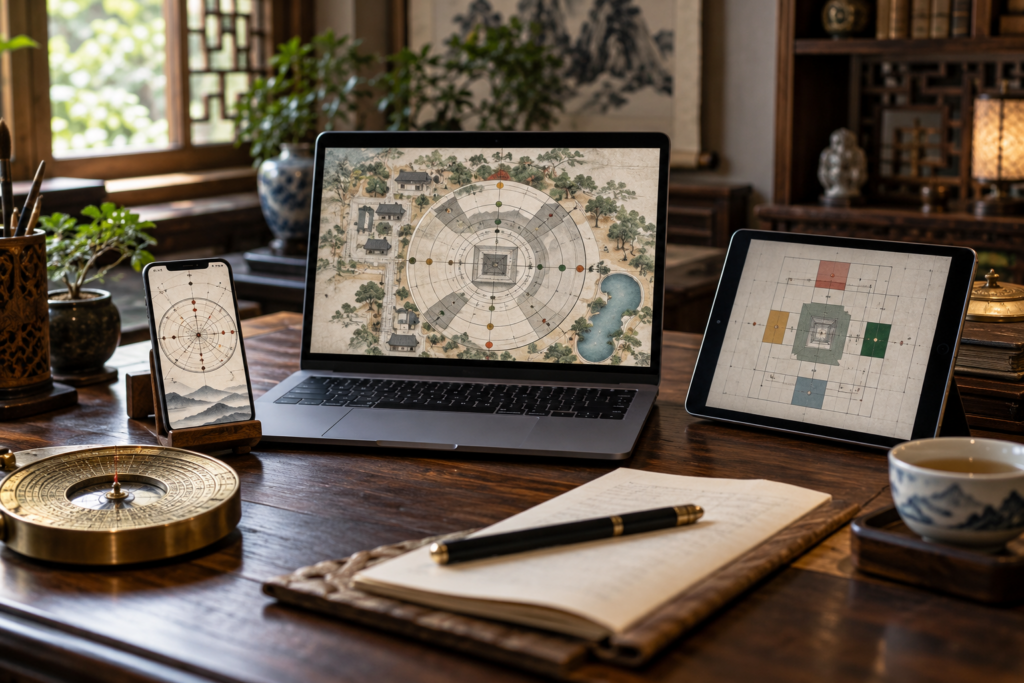
Treat Flying Star Feng Shui predictions as traditional interpretations of a space mapped across time—not as guaranteed forecasts of personal events. First verify the property’s direction, the map’s date or time layer, and the method used. Flying Star readings focus on a location’s mapped sectors and changing pattern; general zodiac horoscopes focus on a person’s zodiac sign. These are distinct traditional approaches, and neither guarantees an outcome.
Start here: check the map before interpreting the prediction
If a Flying Star prediction seems contradictory, alarming, or too vague to use, do not immediately change a room or make a major decision. First check what the map represents and whether its inputs match your question. A Flying Stars calculator is described as mapping shifting energies in a space; that is different from a BaZi calculator, which uses birth data to analyse a person within that tradition. [S1]
- Identify the place. Confirm the property or unit and the floor you intend to map.
- Check the directional input. Find out how the tool defines the building’s facing direction and whether you entered or confirmed it correctly.
- Check the date layer. Establish whether you are looking at an annual, monthly, or other map. Do not compare different time layers as if they were the same forecast.
- Read the legend and method. Star labels and interpretations can depend on the school or practitioner. Feng Shui includes different perspectives and applications, so a label should not be treated as a universal instruction. [S2]
- Turn the interpretation into a modest question. For example, ask whether the reading suggests reviewing how a room is used—not whether it proves that a particular event will happen.
Compass measurements and floor plans can be important parts of a detailed Feng Shui report; the Feng Shui Society’s guidance asks practitioners to show floor plans, compass sectors, calculations, and their reasoning. [S1] If your reading lacks clear inputs, pause and verify them before relying on its interpretation.
Sources: fengshuisociety.org.uk; ifsguild.org
What Flying Star predictions do—and do not—describe
In traditional Flying Star practice, a chart arranges stars across sectors of a space and considers how the pattern changes over time. A prediction is therefore best understood as an interpretation of a mapped location and a specified period, rather than a fixed statement about a person’s fate. The Feng Shui Society describes its Flying Stars calculator as mapping shifting energies in a space. [S1]
Practitioners may use the map to reflect on how a home or workplace is arranged and how a sector is used. But a chart does not establish that a specific event will occur, nor does it prove a physical mechanism. Terms such as energy or qi belong to the traditional interpretive framework; they should not be presented as scientifically proven causes of wealth, illness, relationships, or career outcomes.
That distinction matters most when a reading uses frightening or absolute language. A responsible interpretation should explain its method, acknowledge uncertainty, and offer practical options that are reasonable for the occupants. The Feng Shui Society’s practitioner guidance advises clear explanations, practical recommendations, and avoiding fear-based language and unsupported health claims. [S1]
Sources: fengshuisociety.org.uk
How they differ from general Chinese zodiac horoscopes
The available sources do not define one standard method for every general Chinese zodiac horoscope. The useful distinction is that a general zodiac horoscope is usually presented as a reading about a person, while Flying Star Feng Shui maps sectors of a space and interprets a pattern for a selected period. The sources specifically distinguish a space-mapping Flying Stars calculator from a BaZi calculator that uses birth data to analyse a person. [S1]
Do not confuse Flying Stars with BaZi simply because both may appear on a Feng Shui website. The Feng Shui Society lists BaZi calculators as tools for analysing personal energy based on birth data, while it describes its Flying Stars calculator as mapping shifting energies in a space. It also lists the Tong Shu as an almanac traditionally used for choosing dates. These are related traditional tools, but they address different questions. [S1]
Nor is there one universally used Feng Shui approach. The International Feng Shui Guild describes multiple perspectives and says Classical Feng Shui studies can include direction, zodiac animals, sectors, and Flying Stars. That overlap does not make a zodiac horoscope and a Flying Star map interchangeable. Ask which method produced a claim before comparing it with another reading. [S2]
Sources: fengshuisociety.org.uk; ifsguild.org
Troubleshoot common prediction problems
The map appears to change when I select another date. Check whether you changed the year, month, or another time setting. Compare like with like, and ask the provider what calendar convention it uses. Solar terms are astronomical divisions of the ecliptic, with 15 degrees of solar longitude between successive terms. This helps explain why date conventions can matter in traditional calendars, but it does not by itself specify the boundary rule for a particular Flying Star system. [S3]
Two tools show different results. Compare their inputs and methods before deciding that one must be wrong. Check the location, facing direction, selected period, and any stated school or calculation convention. Feng Shui approaches vary, and different applications are part of that landscape. [S2]
The prediction sounds like a guarantee. Treat certainty about a future event as a warning sign, not as proof. Ask what the chart actually maps, what assumptions were used, and what alternative interpretations exist. A traditional reading is not a guarantee of health, wealth, safety, or success.
I am being told to make a costly or disruptive change. Request the reasoning in plain language. Consider low-cost, reversible adjustments first, and do not substitute Feng Shui advice for medical, financial, legal, or building-safety guidance.
The output is hard to understand. Ask for the map legend, sector orientation, time layer, and an explanation of any translated terminology. The Feng Shui Society cautions that direct translations may sound inauspicious when read literally and recommends seeking clarification rather than interpreting them strictly. [S1]
Sources: fengshuisociety.org.uk; ifsguild.org; hko.gov.hk
A careful way to use a prediction
Use a prediction as a prompt for reflection, not as a command. Keep the map, the interpretation, and any real-world decision separate: record what the chart says, note the practitioner’s reasoning, then decide whether a practical and proportionate response makes sense for your circumstances. If the interpretation creates fear or pressure, pause and seek a clearer explanation.
When evaluating a tool, verify that it produces the map you intended and that you can identify its date layer and directional assumptions. The Feng Shui Society describes a Flying Stars calculator as a tool for mapping shifting energies in a space. [S1] Flyingstar.Online offers a five-language Flying Star mapping app and a calendar covering 2024–2035. These are mapping and calendar features, not guarantees that an interpretation will predict events or produce a particular result.
The app offers an eligible card-backed 30-day trial, then costs USD 99 monthly until canceled. Canceling ends subscription app access immediately. Independent Cloudflare licenses are supported. Review the subscription terms and make sure the trial and cancellation conditions suit you before starting.
Sources: fengshuisociety.org.uk
Limitations: what a map cannot settle
A map cannot prove that a traditional interpretation is a physical cause of events, establish that a prediction will come true, or tell you with certainty which choice will succeed. Results can depend on the inputs, calendar conventions, and interpretive school. The available sources describe Flying Stars as a traditional Feng Shui mapping tool and show that Feng Shui has multiple approaches; they do not validate predictions as guaranteed outcomes. [S1] [S2]
Use ordinary evidence and qualified professional advice for consequential decisions. Do not delay medical care, take financial risks, or undertake unsafe renovation because of a prediction. If a reading is unclear, ask for its assumptions and a practical explanation—or set it aside.
Sources: fengshuisociety.org.uk; ifsguild.org
Quick verification checklist
Before sharing, acting on, or comparing a Flying Star prediction, see whether you can answer these questions:
- Which property, floor, or unit does the map cover?
- What direction and measurement method were used?
- What date, year, month, or other time layer is shown?
- Which Feng Shui method or interpretation is being applied?
- Can the person explaining it distinguish traditional belief from proven fact?
- Is the suggested response proportionate, practical, and reversible?
- Would I make the same consequential decision using ordinary evidence and appropriate professional advice?
If you cannot verify the first four points, treat the prediction as incomplete. If the recommendation depends on fear or promises a guaranteed result, do not treat that promise as evidence.
Sources: fengshuisociety.org.uk; ifsguild.org
Prediction triage checklist: verify, interpret, decide
- Verify: Match the property, direction, date layer, and stated method to the question you are asking.
- Interpret: Ask what the chart says in plain language and which parts are traditional symbolism rather than measurable claims.
- Compare: If readings conflict, compare their inputs and conventions before comparing their conclusions.
- Decide: Prefer practical, low-risk actions. Do not let a prediction replace professional advice or evidence.
- Review: Note what you changed and why, without treating later events as proof that the prediction caused them.
Sources: fengshuisociety.org.uk; ifsguild.org
Decision table: what to do when a reading raises a concern
| What you notice | First verification step | Prudent response |
|---|---|---|
| Different charts for the same property | Compare direction, date layer, and method | Resolve input differences before interpreting |
| A prediction uses absolute or frightening language | Ask what the chart supports and what remains interpretation | Pause; reject pressure or guarantees |
| Unclear star labels or translations | Request the legend and plain-language explanation | Do not infer a literal meaning from an unfamiliar term |
| A recommendation is expensive or disruptive | Ask for the rationale and possible alternatives | Consider reversible options; use relevant professional advice |
| A tool’s date boundary is unclear | Ask which calendar convention it follows | Do not assume another calendar’s boundary applies |
Sources: fengshuisociety.org.uk; ifsguild.org; hko.gov.hk
Frequently asked questions
Are Flying Star Feng Shui predictions the same as Chinese zodiac predictions?
No. In broad usage, zodiac horoscopes are presented as readings about a person, while Flying Star readings map sectors of a space and interpret a pattern over time. Feng Shui traditions may combine approaches, so ask which method a particular reading uses. The sources distinguish space mapping by Flying Stars from birth-data-based BaZi analysis. [S1] [S2]
Sources: fengshuisociety.org.uk; ifsguild.org
Can a Flying Star prediction tell me exactly what will happen?
No guaranteed outcome follows from a traditional map. Treat its interpretation as a belief-based reflection about a space, not proof that a specific event will occur or a substitute for evidence-based decisions. The Feng Shui Society advises against fear-based language and unsupported health claims in practitioner guidance. [S1]
Sources: fengshuisociety.org.uk
Why might two Flying Star calculators disagree?
Their inputs or conventions may differ, including the property direction, selected time layer, or interpretive approach. Compare those details first. Feng Shui includes different perspectives and applications, so a disagreement does not automatically show which reading is correct. [S2]
Sources: ifsguild.org
Should I make a major decision because a prediction says a sector is unfavorable?
Do not make a consequential health, financial, legal, or safety decision on that basis alone. Ask for a clear explanation, consider low-risk practical options, and consult the relevant qualified professional where needed. The Feng Shui Society recommends practical, clearly explained guidance and cautions against fear-based language. [S1]
Sources: fengshuisociety.org.uk
Three follow-up checks
What inputs should I verify before trusting a Flying Star map?
Check the property and floor, facing direction, selected date layer, and calculation method. Ask how each was established and whether it matches the question you are asking.
Sources: fengshuisociety.org.uk; ifsguild.org
How can I compare annual and monthly Flying Star readings?
Make sure each chart clearly identifies its time layer, then compare only equivalent periods and methods. If the boundary convention is unclear, ask the tool provider rather than guessing.
Sources: hko.gov.hk
What should I ask a practitioner who makes a strong prediction?
Ask which map, inputs, and traditional interpretation support the claim, what uncertainty remains, and whether there is a practical alternative that avoids fear or costly pressure.
Sources: fengshuisociety.org.uk; ifsguild.org
Continue exploring
- Annual Flying Star Feng Shui Forecast: How to Check the Year’s Map
- Annual and monthly Flying Stars: how to compare the layers
- Choosing a Flying Star calculator: compare the workflow, not the promise
Prepared with AI assistance and source checks. Traditional interpretation does not guarantee outcomes.
Public article mirrors: JSON · JSONL · CSV collection