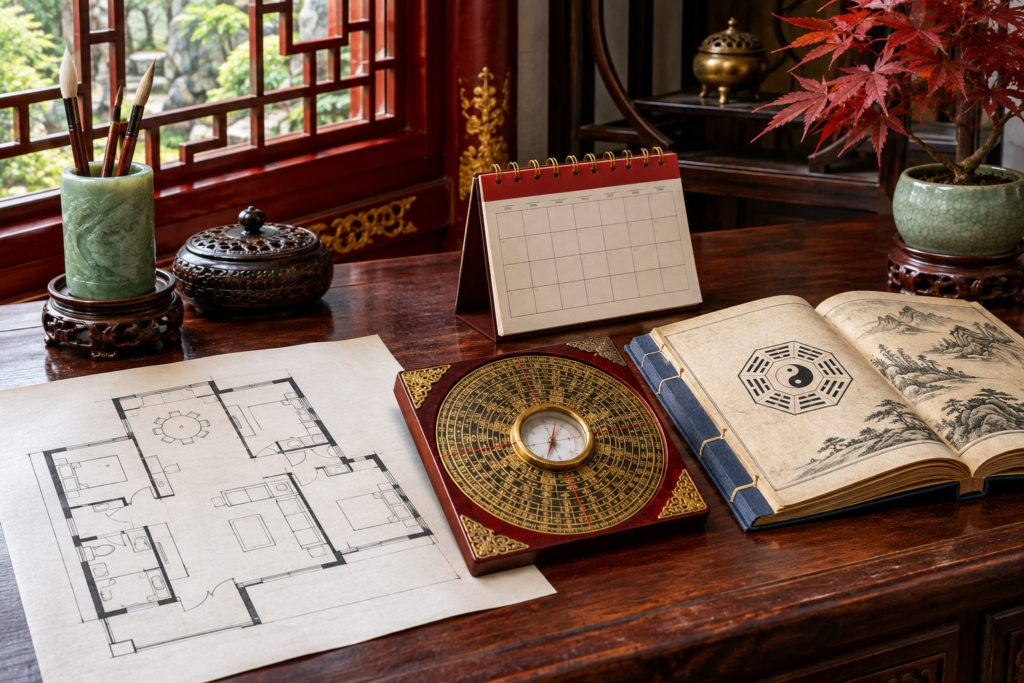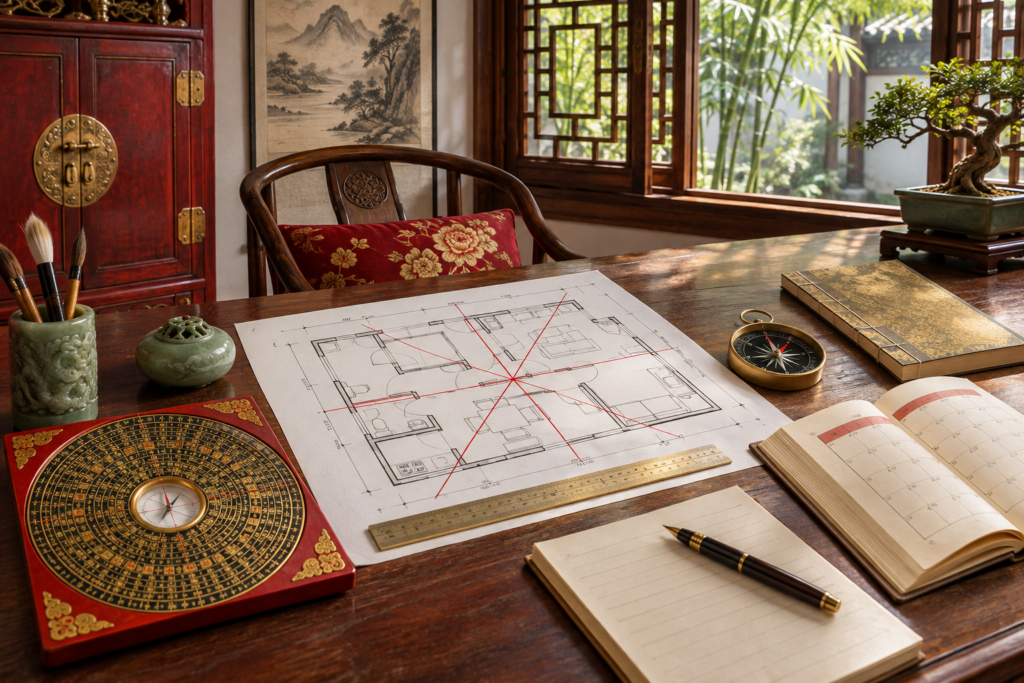
Read an annual Flying Star feng shui chart as a time-based traditional reference layer. Confirm the chart’s year and date convention, place each annual number in the correct compass sector, compare it with the home’s natal chart and actual room use, then choose proportionate practical actions rather than treating one number as a prediction.
You have the annual grid, but do not know what applies to your room
An annual Flying Star feng shui chart is a nine-sector grid of yearly numbers, but the grid alone does not identify what to change in a particular home. Before interpreting any sector, you need to connect the annual chart to a measured floor plan, the building’s natal Flying Star chart, and the way people actually use each area.
In Flying Star traditions, the annual chart is generally treated as a changing layer rather than a complete reading on its own. A useful review compares that moving layer with the building’s more stable natal configuration and the practical conditions of the space.
Feng shui is a longstanding set of traditions focused on homes, workplaces, landscapes, compass readings, and spatial arrangement. Schools and practitioners can use different tools and terminology. [S2] Traditional Flying Star interpretations should be treated as a reflective framework, not as proven physical mechanisms or guaranteed forecasts.
Sources: International Feng Shui Guild
Gather four inputs before you interpret the annual chart
Prepare these inputs before assigning any meaning to a number:
- The annual chart: Keep a record of its year label, source, and annual-transition convention.
- A measured sector plan: Mark the centre of the home or unit and apply your selected compass-sector layout consistently.
- The natal Flying Star chart: Keep annual and natal numbers separate so the annual layer does not overwrite the fixed chart.
- An occupancy map: Note the main use of each area, such as entrance, bedroom, desk, cooker, bathroom, storage, or renovation zone.
Direction is an input to measure and document, not a front-door assumption. This is particularly important where a property has several active entrances, an irregular footprint, or rooms that span more than one sector.
Also distinguish Gregorian dates from lunar-calendar dates rather than assuming they align. The Hong Kong Observatory publishes Gregorian–lunar conversion tables and notes that rare dates close to midnight may have a one-day discrepancy when a new moon or solar term falls near midnight. [S1]
Sources: Gregorian-Lunar Calendar Conversion Table
Place annual stars onto the floor plan without mixing the layers
Orient the floor plan to the same directional reference used for your compass measurement. Locate the chosen centre point, apply the sector grid, and transfer each annual number from the annual chart into its matching directional sector.
Use a simple three-line record in every sector: annual, natal, and use. For example: “Annual: [number]; Natal: [number pair]; Use: guest bed and bookcase.” This makes it easier to see which information is temporary, which is fixed within the selected method, and which reflects real daily activity.
If a room crosses sector boundaries, do not force the whole room into one label. Mark meaningful activity points separately, such as the bed, desk, main doorway, cooker, or frequently used seating. This gives you a more precise review than assigning a broad label to a large room.
Keep a record of the raw inputs behind the map: compass direction, floor plan, centre-point choice, building-period assumption, selected annual chart, and reference date. A map that can be checked later is more useful than one that only looks complete.
Professional feng shui guidance emphasizes explaining methodology clearly and in language clients can understand. [S3]
Sources: The Feng Shui Society
Read every sector through three layers
Use the same sequence for all sectors so that one memorable number does not dominate the review.
- Annual layer: Record the yearly number exactly as it appears in the chart you selected.
- Natal layer: Record the fixed natal numbers assigned to that sector within your Flying Star method.
- Human-use layer: Identify how intensively the area is used. A main entrance, bed, desk, or cooker has greater everyday relevance than an unopened cupboard.
- Traditional interpretation: Consult the rules of your own lineage, teacher, or study source and write whether the combination is considered supportive, challenging, or mixed in that tradition.
- Practical response: Choose a low-risk action that remains useful regardless of belief, such as clearing clutter, improving lighting, reducing noise, repairing hazards, or improving circulation.
Not every sector needs equal attention. Rank each one by the confidence of your inputs, the intensity of room use, and how reversible the proposed action is. Moving a chair or reorganising a desk is easier to review than paying for permanent construction.
The Feng Shui Society’s published consultation guidance asks for methodology and decision-making to be explained, and it encourages practical, solution-oriented recommendations. [S3]
Sources: The Feng Shui Society
Use traditional interpretations without turning them into predictions
Some Flying Star traditions associate numbers and combinations with specific life themes. Those associations are traditional symbolic interpretations, not evidence that a particular event will happen.
A proportionate note might read: “This annual and natal combination is considered more active in this tradition; review how this room is used and avoid expensive decisions based only on the chart.” That wording identifies the tradition, preserves uncertainty, and leaves room for practical judgment.
By contrast, it is not responsible to state that a sector will cause illness, guarantee wealth, determine relationships, or assure a business result. The Feng Shui Society specifically advises against fear-based language and against medical or health claims without supporting evidence. [S3]
Use the chart to structure observation: what is located in the sector, how often it is used, whether there are ordinary maintenance issues, and whether a modest environmental improvement would make sense. Use relevant qualified professionals for health, safety, legal, structural, or financial decisions.
Sources: The Feng Shui Society
Run an annual review that produces a usable record
Complete one full review near the annual transition used by your selected system. Revisit it if the practical use of the home changes substantially, such as after a renovation, a bedroom move, a new work-from-home arrangement, or a change to the main entrance route.
Start by verifying the map. Then walk through each sector with the plan, identify daily-activity areas, list routine maintenance needs, and compare the annual and natal entries. Select no more than three reversible improvements to try first, recording the date and what changed.
Flyingstar.Online supports this workflow with Flying Star mapping and a calendar covering 2024–2035 in five languages. It is designed for traditional interpretation and does not guarantee wealth, health, rankings, or other outcomes. Eligible card-backed trials last 30 days, followed by USD 99 monthly until cancelled. Cancellation ends subscription app access immediately. Independent Cloudflare licenses are supported.
Calendar references should remain explicit in your notes, particularly when comparing Gregorian dates, lunar dates, and solar-term-based annual conventions. [S1]
Sources: Gregorian-Lunar Calendar Conversion Table
Limitations and when to pause
An annual Flying Star chart does not replace building safety decisions, medical care, mental-health support, financial planning, legal advice, or qualified trade work. Do not delay repairs, accessibility work, emergency preparation, or professional care because a chart suggests waiting.
Interpretation also depends on choices that a generic annual chart cannot settle: annual-transition convention, compass-reading accuracy, building-period determination, centre point, sector method, and school of interpretation. A calendar conversion table can help check date systems, but it does not validate a particular feng shui method. [S1]
If you seek an external consultation, ask for a plain-language explanation of the method, assumptions, and recommendation. Professional organisations provide directories, educational resources, and reporting expectations, but a listing or membership alone does not establish that a particular interpretation is correct. [S2] [S3]
Sources: Gregorian-Lunar Calendar Conversion Table; International Feng Shui Guild; The Feng Shui Society
Derived tool: annual chart input-and-placement checklist
Use this checklist before interpreting any annual sector:
- □ I recorded the chart year and the annual-transition convention used.
- □ I identified whether my reference date is Gregorian, lunar, or linked to a solar-term convention.
- □ I retained the annual chart source or calculation record.
- □ I measured and recorded the relevant property direction.
- □ I marked a centre point and sector grid on the correct floor plan.
- □ I labelled each sector separately with annual, natal, and room-use information.
- □ I marked high-use locations, including beds, desks, entrances, cookers, and main seating.
- □ I identified activity points that cross sector boundaries.
- □ I described interpretations as traditional and conditional, not predictive.
- □ I selected reversible, practical first actions wherever possible.
- □ I set a review date and recorded what actually changed in the space.
Conversion tables can help verify calendar references, while rare near-midnight new-moon or solar-term boundaries should be documented rather than ignored. [S1]
Sources: Gregorian-Lunar Calendar Conversion Table
Derived tool: sector action decision table
| What you find | Confidence in inputs | Room intensity | Proportionate next step |
|---|---|---|---|
| Annual number is placed, but direction or centre is uncertain | Low | Any | Pause interpretation. Recheck direction, floor plan, centre point, and sector placement. |
| Annual and natal entries are recorded; space is rarely used | Medium or high | Low | Make a note and address ordinary maintenance. Avoid costly changes based only on the chart. |
| Annual and natal entries are recorded; desk, bed, or entrance is heavily used | High | High | Prioritise comfort, order, lighting, safe circulation, and noise reduction. Record traditional interpretation separately. |
| The reading feels alarming or highly prescriptive | Any | Any | Do not act from fear. Request a clear explanation of the method or seek another informed perspective. |
| The action affects health, safety, finances, or structure | Any | Any | Use an appropriately qualified professional; do not let chart symbolism override evidence-based advice. |
This table turns uncertainty into a verification step and keeps traditional symbolism separate from high-stakes decisions. The Feng Shui Society cautions against fear-based language and unsupported health claims. [S3]
Sources: The Feng Shui Society
Frequently asked questions
How do I read an annual Flying Star feng shui chart?
Confirm the chart’s applicable year, align it to a measured sector plan, write each annual number into its matching sector, then compare it with the natal chart and room use. Interpret combinations only within your selected tradition, and choose practical actions without assuming predicted outcomes.
Sources: The Feng Shui Society
Should I use the annual chart by itself?
No. A more disciplined reading keeps the annual layer distinct from the home’s natal configuration and actual room use. A frequently used doorway, desk, or bed may deserve closer review than an unused sector, but neither proves that a particular outcome will follow.
Sources: The Feng Shui Society
When does an annual Flying Star chart start?
It depends on the convention used by your selected Flying Star source. Record that convention rather than assuming January 1 or lunar New Year. When checking dates across calendar systems, use a conversion reference and note that rare near-midnight solar-term or new-moon boundaries can create a one-day discrepancy. [S1]
Sources: Gregorian-Lunar Calendar Conversion Table
Can an annual Flying Star chart predict health or wealth?
No responsible reading should promise health, wealth, relationship, or business outcomes. Flying Star meanings are traditional spatial interpretations, not proven causal mechanisms. Avoid fear-based claims and unsupported health claims, and use qualified medical, financial, safety, and legal advice for decisions in those areas. [S3]
Sources: The Feng Shui Society
What should I ask a feng shui consultant about an annual chart?
Ask which school and annual date convention they use, how directions and the building period were established, how annual and natal layers were combined, and why each recommendation is practical. Ask for clear language without fear-based claims. Professional organisations describe training, directories, and methodological reporting expectations. [S2] [S3]
Sources: International Feng Shui Guild; The Feng Shui Society
Three follow-up checks
Which annual transition convention does my selected Flying Star chart use, and what date marks its start this year?
Verify the chart publisher’s stated convention first. Then cross-check Gregorian and lunar dates where relevant, documenting boundary uncertainty instead of assuming all calendar systems use the same date. [S1]
Sources: Gregorian-Lunar Calendar Conversion Table
Have I measured the property direction and mapped each high-use room area to the correct compass sector?
Recheck directional measurement, centre point, and floor-plan orientation. Record beds, desks, entrances, and cookers separately if they sit near or across sector boundaries; clear methodology supports review. [S3]
Sources: The Feng Shui Society
Can every proposed annual-chart action be explained as practical, reversible, and free of health or financial promises?
Rewrite alarming claims as conditional traditional notes. Keep health, safety, structural, legal, and financial decisions with appropriately qualified professionals, rather than relying on chart symbolism alone. [S3]
Sources: The Feng Shui Society
Continue exploring
- How to Create a Flying Star Feng Shui Chart: A Reliable Input-to-Map Workflow
- Annual Flying Star Forecasts: How to Read the Year Without Ignoring Your Home’s Natal Chart
- Annual and monthly Flying Stars: how to compare the layers
Prepared with AI assistance and source checks. Traditional interpretation does not guarantee outcomes.
Public article mirrors: JSON · JSONL · CSV collection